
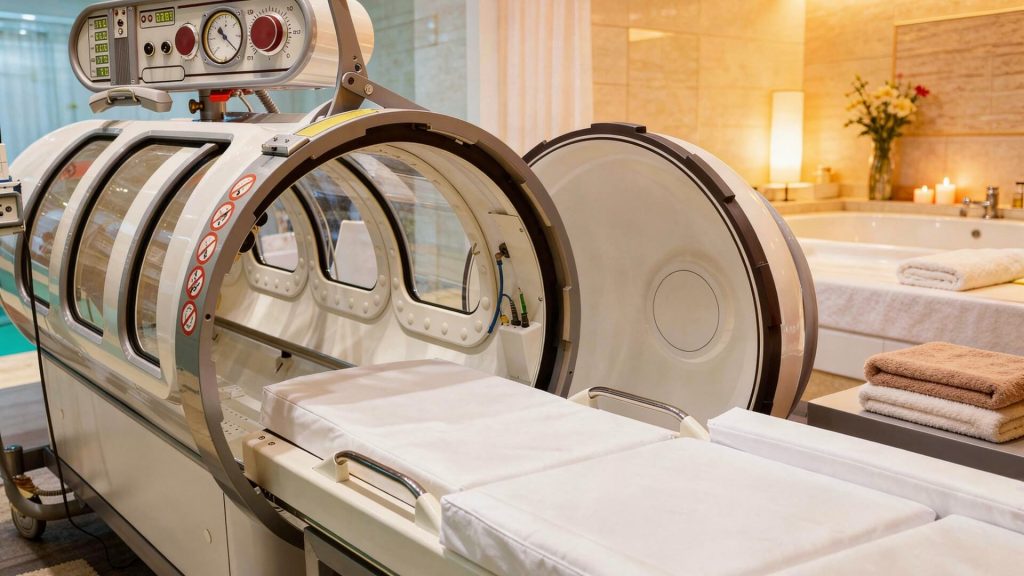
Hyperbaric Oxygen Therapy (HBOT) programs can significantly expand a med spa’s ability to treat complex wounds, neurological issues, and other difficult conditions, but they require careful, standards-driven setup. Launching an HBOT program involves more than purchasing a chamber. It requires deliberate planning around clinical indications, facility design, staffing, and risk management.
Understanding these essentials enables med spas to integrate the therapy in a way that enhances outcomes while protecting patients, staff, and the organization.
Equipment Selection
The foundational decision in setting up a Hyperbaric Oxygen Therapy program is whether to install monoplace or multiplace chambers, as this drives space, staffing, and workflow requirements.
Monoplace chambers, which treat one patient at a time in an acrylic cylinder, are often favored in outpatient wound centers or med spas for their smaller footprint and simpler operation. In contrast, multiplace steel chambers allow multiple patients and in-chamber attendants but require more complex infrastructure.
Beyond chamber type, planners must consider pressure ratings, control systems, communication features, fire-suppression compatibility, and whether the primary gas supply will be oxygen cylinder banks, liquid oxygen, or a centralized system integrated with the facility.
When purchasing an HBOT chamber, working with a proven manufacturer that meets medical safety standards and provides ongoing technical support is critical to long-term success. For med spas and wellness centers that are interested in providing HBOT therapy in their establishments, we at INNERGY Dev can offer you our Hyper-Cube hyperbaric chamber, which seamlessly integrates into med spa portfolios and delivers superior wellness outcomes.
Facility Requirements
An HBOT program must be housed in a space designed for both efficiency and hyperbaric safety. This typically includes a dedicated treatment room with sufficient clearance around the chamber for maintenance and emergency access, adjacent control and monitoring areas, and nearby changing and waiting spaces to ensure smooth patient flow.
Building services such as ventilation, fire protection, electrical systems, and gas piping must be designed or upgraded to meet applicable codes, and the layout should facilitate quick transport of patients from other areas, particularly if acutely ill or on stretchers.
Training Essentials
Effective HBOT programs depend on clinicians and technical staff who are specifically trained in hyperbaric medicine, not just general wound care or emergency care.
Physicians overseeing treatments should have formal education in hyperbaric indications, contraindications, and treatment protocols, while nurses and technologists need hands-on training in chamber operation, patient preparation, monitoring, and documentation.
Ongoing education should cover topics such as barotrauma prevention, oxygen toxicity recognition, emergency decompression procedures, and equipment troubleshooting, reinforced by regular drills and competency assessments.
Safety Protocols
Safety is central to HBOT because treatments involve high oxygen concentrations and elevated pressures that raise the risk of fire and certain medical complications.
Programs must implement strict controls on what materials and devices may enter the chamber, develop checklists for patient screening and pre-treatment preparation, and enforce clothing and equipment requirements designed to minimize ignition sources.
In addition, written emergency procedures for events such as seizures, rapid decompression needs, power failures, and suspected fires must be in place, rehearsed by staff, and coordinated with facility-wide emergency response plans and local fire services where appropriate.

Staffing and Operations
An HBOT service requires more than a supervising physician. It needs a defined team structure with clear roles and coverage plans. A typical model includes:
- a medical director for clinical oversight
- a hyperbaric safety officer or technical director for equipment and safety systems
- appropriately trained nurses or technologists to operate the chamber and monitor patients during every treatment.
Daily operations should be built around standardized protocols for scheduling, patient education, informed consent, baseline assessments, treatment logging, and follow-up, ensuring consistency and traceability from the first consultation through completion of a treatment course.
Regulatory Compliance
To operate responsibly, HBOT programs must align with national and local regulations covering medical gases, high-oxygen environments, building codes, and healthcare practice standards.
This usually includes ensuring that chambers are cleared or approved as medical devices, that facility design adheres to relevant fire and life safety standards, and that the establishment’s practice follows recognized hyperbaric guidelines for credentialing, privileging, and quality assurance.
Programs should maintain thorough records of maintenance, gas quality checks, incident reports, and staff training, and may benefit from seeking external accreditation or certification to demonstrate adherence to best practices.
Cost and Implementation
Setting up an HBOT program in a med spa demands substantial capital investment alongside ongoing operational expenses, requiring meticulous financial planning integrated with facility design and regulatory compliance.
Upfront costs typically range from $50,000-$250,000+ depending on chamber type—such as a single monoplace chamber ($75,000-$150,000) or multiplace unit ($200,000+), plus facility renovations for pressure-rated rooms with blast-proof doors, HVAC upgrades, oxygen supply systems (concentrators or tanks at $10,000-$30,000), advanced monitoring equipment like vital signs trackers and fire suppression ($5,000-$20,000), and comprehensive staff training certifications in hyperbaric safety and emergency protocols ($2,000-$10,000 per course).
Recurring expenses include chamber maintenance contracts ($5,000-$15,000 annually), medical-grade oxygen and filters ($1,000-$5,000 monthly), dedicated staffing (nurses or technicians at $80,000-$120,000/year per FTE), utilities for pressurization, and accreditation/inspection fees from bodies like the Undersea and Hyperbaric Medical Society ($3,000-$10,000 yearly).
Final Thoughts from INNERGY Dev
Establishing an HBOT program requires coordinated decisions on equipment, facility design, staff training, and safety management, rather than a single purchase or policy change. Investing in appropriate chambers, building a well-trained multidisciplinary team, and embedding rigorous safety and regulatory practices into daily operations lets organizations deliver hyperbaric therapy that is both effective and operationally resilient. With thoughtful planning, the treatment can become a high-impact addition to a broader continuum of wellness care.
We at INNERGY Dev recommend integrating our Hyper-Cube hyperbaric chamber into your HBOT program for seamless wellness enhancement. This spacious, hardshell unit, with its non-medical, user-friendly controls and safety-focused features like insulation and purified air, complements setups by supporting recovery sessions alongside therapies such as PEMF and others, ensuring that your program delivers innovative, accessible wellness sessions for optimal patient outcomes.